Well first things first, if I were to ever interview Egaeus from "Berenice" by Edgar Allen Poe there would be some things that would have to be done before I agreed to it. Straight jacket, shackles, and a shatter proof glass between us. This guy pulled Berenice's teeth out and clearly has some severe OCD or even schizophrenia. God forbid he took a liking to my hair and tried to rip it out. Nooo nope, not ok. Anyhow, if I were to interview him my questions would be less about Berenice and more about his own story. Like where the heck was his father? Did he die too? Does he know if both his parents were related? Poe seems to really like to write about inbreeding and about how inbred people seem to always have mental illnesses so I'm assuming that his parents were related and that's why his health so messed up. Has he ever had other moments where he blanked out and then realized that he had done something while he was blanked out and didn't remember? He seems to not really care for Berenice, could this be because he is jealous that she was beautiful, graceful, and filled with light while he was filled with darkness? Was he obsessed with her teeth because as the beauty and light from her body started to deteriorate due to her illness, her teeth still remained white and shining? Was the library the only place he wanted to be in because it was where his life began but where the life of the woman who gave life to him ended? So many questions for this very deranged man.
"The Furnished Room" by O. Henry really reflects his view of city life because he spends a lot of the time describing the rooms little details and wondering what could have happened before the man got there since a bunch of people have inhabited that room before him. In the beginning of the story it says "the houses of this district, having had a thousand dwellers, should have thousands of tales to tell", this really reflects his fascination with the stories that lie within every house. Reading this story was actually really cool for me because I actually think about things like that a lot. Anytime I stay in a hotel room I always wonder who stayed here before me and what happened in the room. I also tend to move to different houses every year so every time I move into a new home I'm always thinking about how the house was once home to someone else and I wonder what stories they have in the time that they lived there and I ponder how they might have decorated the rooms. Houses, apartments, hotels, and so on contain the stories of the best night of someone's life or maybe the worst year of their life which fascinates me and reading this story was just interesting cause I probably would've been doing the same thing as the main character, just sitting there looking around and wondering how or why those stains got there, etc. BTW super creeped out when it said "Marie" was carved on the wall! I'm reading this at night and reading about my own name being carved on a wall in a creepy story at this time of night is not pleasant.
I don't think "The Boarded Window" by Ambrose Bierce actually contains any supernatural factors in it, only things that seem supernatural. At the end when Murlock falls asleep by his wife's dead body we're told he hears wailing sounds, which we might assume is the beginning of a supernatural occurrence. Later on after he wakes up he sensed that there was something there. A ghost perhaps? As the story goes on he hears foot steps and the table shakes beneath him. When he can't find it in him to say his deceased wife's name and is too scared to reach out for her we might think that the wife's body has become possessed or something and is now the living dead. When he was hit by the table and there were scuffling sounds everywhere the idea that the wife had become some type of living dead may have been reassured. Especially when he reaches out for her and there is nothing on the table anymore. It says in the story "there is a point at which terror may turn to madness" which means Murlock probably thought that his wife went zombie on him too. However after he shoots his rifle we found out that it was actually just a panther. The horrify-ling funny thing is that the next morning we find out Murlock's wife wasn't the living dead, she was just living. Murdock basically set up his wife's death by binding her hands and laying her on a table next to a window which attracted the panther and left her helpless since her hands were bound. This story just kinda proves that every one becomes a madman when they're scared.
Tuesday, March 31, 2015

Thursday, March 26, 2015
Blog Post 10
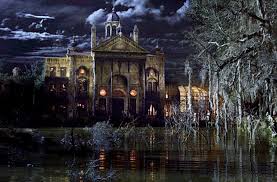
After reading "The Fall of the House of Usher" you can really see what modern day haunted houses took from this story. The stereotypes of a haunted house that are in this story are things like the creepy, shiver down your spine, feel you get when you just look at the house. Not to mention that there's a strange glow and a dark creepy lake next to it. Oh and an underground tomb. Poe turns regular objects into seeming creepy. I mean if he decided to go as far as to describe a dust particle it would probably be creepy too. The description of the mansion made me think of the Disney movie The Haunted Mansion which shows how this story inspired the modern day haunted house.

Afterward by Edith Wharton definitely fits the definition of an American Gothic. The story has immense amounts of suspense in trying to figure out where or when the ghost is going to show up. I think this story teaches people that getting what you wished for isn't always a good thing, especially when you have no clue when or where that thing is going to show up. Not to mention when the thing you wished for was a ghost.

Afterward by Edith Wharton definitely fits the definition of an American Gothic. The story has immense amounts of suspense in trying to figure out where or when the ghost is going to show up. I think this story teaches people that getting what you wished for isn't always a good thing, especially when you have no clue when or where that thing is going to show up. Not to mention when the thing you wished for was a ghost.
Wednesday, March 18, 2015
Blog Post 9
"The Raven" by Edgar Allen Poe makes me think about those nights that you stay up till 4 am and you can't sleep but you're so exhausted that your mind starts going a little crazy and you become super paranoid. I don't know maybe that just happens to me. Poe seems to be trying to communicate that very sense of paranoia. The speaker constantly kept repeating to himself "‘Tis some visitor entreating entrance at my chamber door—/Some late visitor entreating entrance at my chamber door;—/ This it is and nothing more.” every time he heard the tapping sound. He was trying to convince himself that he wasn't going nuts. When he finally decided to attend to the visitor he realized there was nothing there except darkness. He spoke the name Lenore into the darkness as if he expected the deceased woman to respond. At this point he was really losing his marbles.
He went back into the room and opened the window because he thought the sound was the
wind hitting the shutters. Now a Raven has flown into the room and sits upon a bust and when he
speaks to the bird it replies with "Nevermore". Now at this point any sane human would've shit
their pants and ran but instead this man decides to ask it questions. The strange Raven seems to
have uplifted the speakers dark and depressed mood " The Raven still beguiling my sad fancy
into smiling". The speaker begins to think about Lenore and in grief begins yelling at himself to forget her. The
bird interrupts him with his extensive vocabulary of "Nevermore" and this sets him off. He starts yelling at the
bird calling it an evil, even calling it the devil. He starts asking it questions about seeing Lenore despite the fact
that he knows its only answer will be "Nevermore". With this he tells the bird to get lost and basically go to hell.
The Raven once again responds with "Nevermore". By the end of the poem the man has lost all his sanity and is
entrapped in his own personal hell. "The Raven" communicates a very grim feeling of losing all hope and that
can lead to losing your sanity. The mood is really dark and depressing, everything is described as being lifeless
"Once upon a midnight dreary...distinctly I remember it was in the bleak December".
The tone of Annabel Lee seems to be very somber and nostalgic. He clearly misses his childhood sweetheart
very much. The speaker describes their love as something that angels were even jealous of. The song like rhythm
of the poem makes it even more gloomy and mournful sounding.
VIEWING SUGGESTION
The first season of The Following is about FBI agent who is trying to catch a serial killer whose murders are
based on Poe's work. It's really cool, gory, and creepy so if you're into that stuff I suggest you give it a try.
Subscribe to:
Posts (Atom)